(May 28, 2026) Salzburg higher education institutions and the Student Union mobilize thousands of participants – concerns regarding the quality and future of the location.
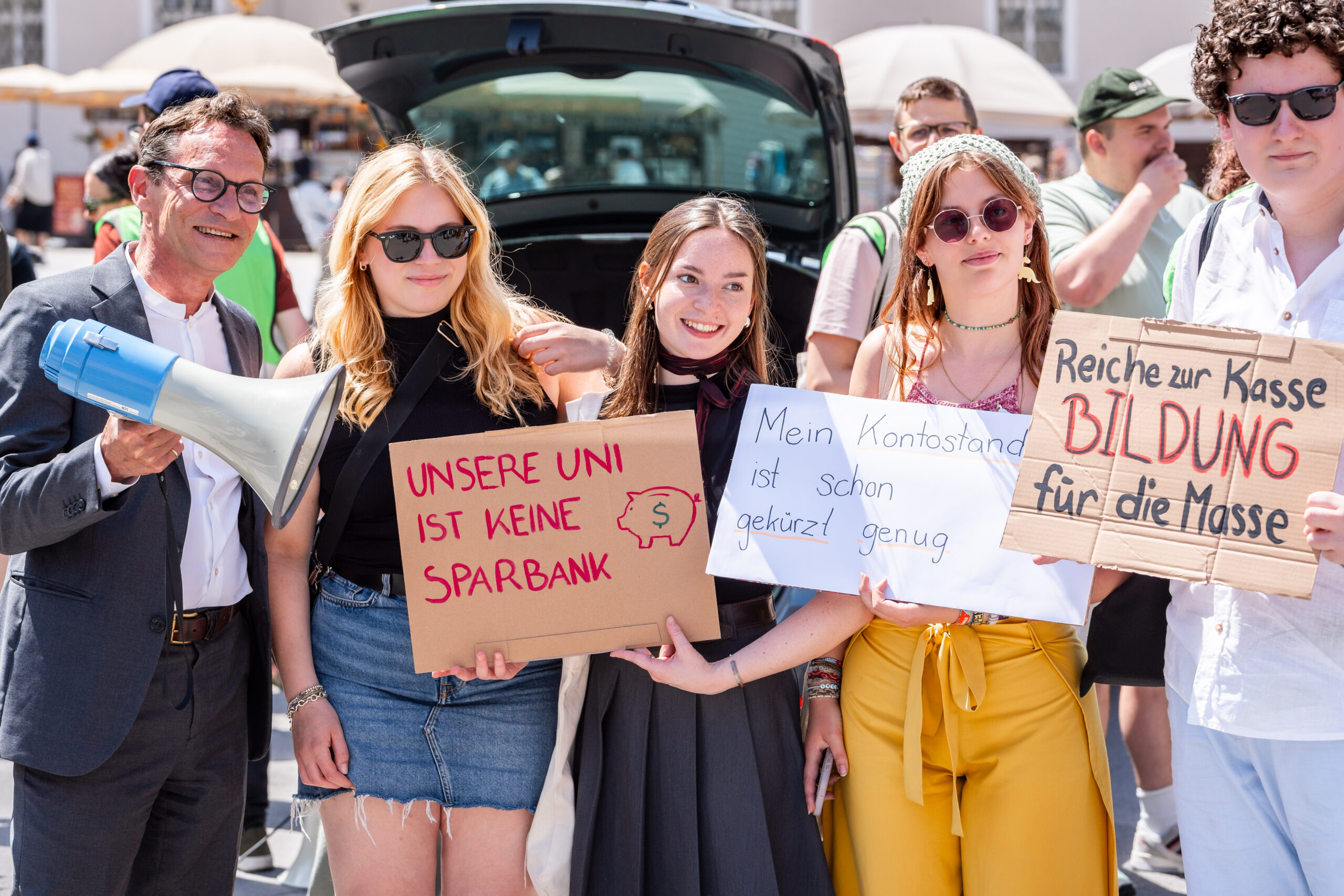
The planned budget cuts for universities are meeting with massive resistance across Austria. Widespread protest has also emerged in Salzburg: the University of Salzburg, the Mozarteum University, and the student unions jointly called for a demonstration in Salzburg’s Old Town yesterday.
According to organizers’ estimates, more than 2,500 students, academic staff, and administrative personnel from both universities marched noisily from Kapitelplatz to Mirabellplatz on Thursday.
The protests are driven by the federal government’s current budget plans for the coming years. While universities have around €16.5 billion at their disposal for the current 2025–2027 period, a reduction to approximately €15.5 billion is being discussed for the 2028–2030 period. University administrations and representative bodies, however, are calling for an increase to at least €18 billion to ensure the long-term quality of teaching and research.
Universities are warning of the tangible consequences of potential cutbacks. Cited examples include overcrowded classes, a reduced range of study programs, and limitations affecting research and staffing. International competition for talent and scientific excellence would also suffer as a result.
As early as Wednesday, around 28,000 people demonstrated in Vienna against the planned cutbacks. The protests continued on Thursday at the university locations of Salzburg, Graz, Linz, and Klagenfurt.
University representatives emphasize the societal importance of adequate university funding, noting that universities are key hubs for education, innovation, and societal development. Consequently, there is significant concern that budget cuts could have long-term repercussions for Austria as a center for science and research.
Marie Stenitzer, Raphaela Vitzthum, and Maja Münch from the ÖH Salzburg University leadership team, along with Andrea Lienbacher, the ÖH chair at the University Mozarteum, used the final rally to issue a clear appeal to the federal government: „Denn die Frage ist nicht, ob wir uns gute Bildung leisten können. Die eigentliche Frage ist: Können wir es uns leisten, darauf zu verzichten? Können wir es uns leisten, eine Generation von Studierenden mit schlechten Bedingungen, Unsicherheit und Überlastung alleine zu lassen? Können wir es uns leisten, Forschung, Wissenschaft und kritisches Denken zu schwächen? Die Antwort darauf muss klar sein: Nein.“ [“For the question is not whether we can afford good education. The real question is: Can we afford to do without it? Can we afford to leave a generation of students to cope on their own with poor conditions, uncertainty, and excessive burdens? Can we afford to weaken research, scholarship, and critical thinking? The answer to this must be clear: No.”]
Rector Bernhard Fügenschuh of the University of Salzburg emphasized once again: „Universitäten spielen eine zentrale Rolle für eine funktionierende Wirtschaft: Sie bringen hervorragend ausgebildete Fachkräfte hervor und treiben durch ihre Forschung Innovationen voran. Am Standort arbeiten wir eng und partnerschaftlich mit anderen Hochschulen zusammen. Salzburg muss weiterhin eine starke Universitätsstadt bleiben. Dafür brauchen wir eine geeinte Stimme, um unsere Position in Verhandlungen zu stärken. Unsere Verantwortung für den Universitätsstandort ist groß und wir nehmen sie ernst.“ [“Universities play a pivotal role in a functioning economy: they produce highly qualified professionals and drive innovation through their research. Locally, we collaborate closely and in partnership with other higher education institutions. Salzburg must remain a strong university city. To achieve this, we need a united voice to strengthen our position in negotiations. We bear a significant responsibility for Salzburg as a university hub, and we take that responsibility seriously.”]
„Salzburg atmet Kunst und Kultur durch jede Pore – das spüre ich, seit ich am 1. April hier begonnen habe“ [“Salzburg breathes art and culture through every pore—I’ve felt that ever since I started here on April 1st.”], says Mozarteum Rector Constanze Wimmer. „Deshalb kommen internationale Gäste hierher, deshalb strahlt Salzburg weit über die Landesgrenzen hinaus. Unsere Universität, die jungen Menschen, die uns ihre Begabung anvertrauen, sind dafür der zentrale Motor. Kürzungen im dargebotenen Ausmaß schneiden tief ins Fleisch der österreichischen Wirtschaft, auch der Kulturwirtschaft. Die Art, wie die Regierung derzeit mit uns spricht, zeigt deutlich, dass es kein Verständnis dafür gibt, was Kunst, Bildung und Wissenschaft für unsere Demokratie bedeuten – und für das Zusammenleben in Österreich. Dagegen protestieren wir, dagegen erheben wir unsere Stimmen. Solange, bis wir auch gehört werden!“ [“That is why international guests come here; that is why Salzburg’s radiance extends far beyond national borders. Our university—and the young people who entrust us with their talents—are the driving force behind this. Cuts of the magnitude proposed strike deep at the heart of the Austrian economy, including the cultural sector. The way the government is currently communicating with us clearly shows a lack of understanding regarding the significance of art, education, and science for our democracy—and for social cohesion in Austria. We are protesting against this; we are raising our voices against it. And we will continue to do so until we are heard!”]
The ongoing protests are placing the federal government under increasing pressure. Federal Minister Eva-Maria Holzleitner and Finance Minister Markus Marterbauer are attempting to calm the situation, pointing out that the final budget allocation will not take place until October.
Photo: Kay Müller
Text: Mag.a Susanna Graggaber (Uni Salzburg), Translation: ÖH Uni Salzburg (TechRef)